How to optimize your compliance with ChatGPT? and BONUS material
Published on
Who hasn’t used ChatGPT nowadays? Now everyone is literally obsessed with it!
When it was just released our team immediately start thinking about how to put it to work and outsource some routine compliance tasks to it. It is always good to have something automated in compliance as you already have enough tasks to do, right?
With ChatGPT your company can ease compliance efforts in various ways.
Main principle when using ChatGPT for compliance matters
The abilities of ChatGPT are still very limited in compliance matters. This is why today we will only discuss the most trivial options for automation.
The main idea in using it is not to outsource your thinking to it. Use it to create a structure around some issues you have.
Getting answers for customer queries
For instance, ChatGPT can provide quick and accurate responses to compliance-related queries and draft requests for customers. This feature can save your customer-facing employees time and effort in writing replies to your customers or creating a bank of templates for customer responses or requests. To do that efficiently, you need to put correct queries and more background facts and conditions to get the most relevant and accurate response. Our team already prepared a bank of the replies that contain more than 100 templates for any situation. The needed templates are easily searchable via key words and contain clear and concise messages written an casual and friendly tone for your customers.
So, let’s practice!
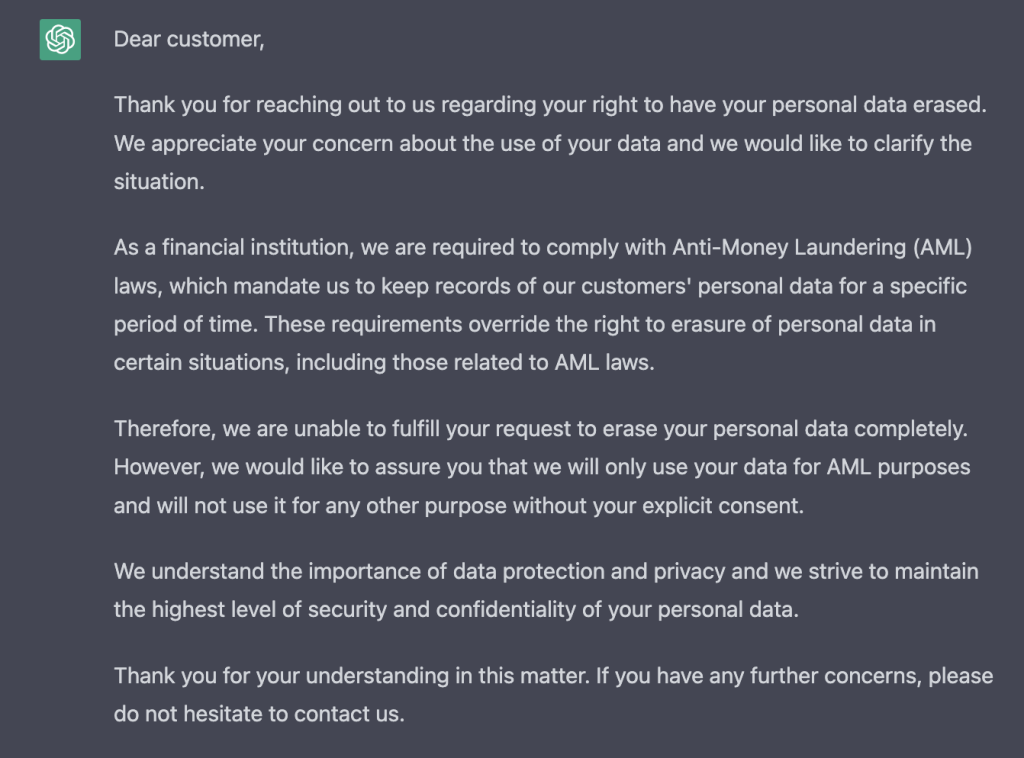
We asked ChatGPT to answer the query of the client who wants to erase his personal data with your company, but you can’t do it since you have an AML obligation to keep the KYC data for [X] years.
ChatGPT comes up with the following answer:
While we still believe, that anything produced by AI needs to be reviewed by humans before sending, it still saves time in drafting.
Optimisation of customer flow
Another significant benefit of ChatGPT is its ability to analyze compliance-related data to identify areas of improvement. By leveraging this data analysis capability, you can address recurring issues and ensure compliance requirements are met. For instance, you have your product or service flow, or customer journey map, you can put it into ChatGPT and ask it for the optimisation.
Drafting of contract clauses
ChatGPT also has a role in drafting clauses in agreements and policies. While it cannot be expected to draft the whole agreement or procedure, it perfectly works when you need to add a separate clause on Anti-Bribery and corruption, Information Security, Data Protection, and Sanctions compliance provisions.
Complaints
Moreover, ChatGPT can be used to draft sample responses to customer complaints and other related issues, making it easier for employees to handle these situations in compliance with your internal policies and regulations.
Marketing
It also can help other teams in your company who are not heavily involved in the compliance matters but still need some guidance on, for instance, email marketing and its compliance with spam provisions: So suggest them to play with ChatGPT: ‘How to Use Email Deliverability Best Practices to Ensure Compliance with Spam Laws‘.
Simplification and compliance training
Lastly, ChatGPT can put complex compliance issues into simpler terms for those who are not in the compliance field. This capability is especially helpful in ensuring that everyone in the organization understands compliance requirements and is equipped to meet them. This particular ability is crucial for trainings. Compliance people may often sound really dry and legalistic. ChatGPT can do a great job here explaining complex terms in a simplistic way with the good real life examples.
In summary, ChatGPT is a powerful tool you can use to optimize compliance processes. Its ability to provide quick and accurate responses to queries, automate compliance-related tasks, analyze compliance-related data, draft legal clauses, draft standard responses, and simplify complex compliance issues makes it a valuable asset to any compliance program and can potentially ease the life of your compliance officer.
Still have questions? Reach out to us via the contact form below and we will provide you with the BONUS material on ChatGPT optimization for compliance for free!
The Markets in Crypto Assets Regulation (MiCAR) is reshaping the landscape of EU crypto regulation, with a focus on fostering innovation while ensuring consumer protection. Starting December 30, 2024, crypto asset service providers (CASPs) in the EU must secure authorisation to continue operating across the EU. A transitional period runs until December 29, 2025, for existing virtual asset service providers (VASPs) to operate without a MiCAR licence. CASPs must meet stringent regulatory requirements, including governance, client asset protection, transparency, and anti-money laundering (AML) compliance. Early engagement with regulators is key to successfully navigating the authorisation process. Get in touch for a free consultation and ensure your business is MiCAR-ready!
Are you unable lo land a job in fintech compliance? As someone who interviews compliance professionals, let me share some insights. Spice up your CV with impactful phrases, not generic responsibilities. Embrace a growth mindset to think outside the box. Don't just identify risks; provide practical solutions. Avoid burdening yourself with unnecessary requirements. Be confident and make decisive moves in the fast-paced fintech world. Stand out, adapt, and demonstrate your value.
Explore the essential role of risk acknowledgment in fintech compliance. Learn why it's a must-have process for organizations navigating regulatory requirements. Discover the practical advantages it offers, including early identification and mitigation of risks, promoting transparency and accountability, and fostering positive relationships with regulators. By embracing risk acknowledgment, you can safeguard your business, ensure compliance, and establish a solid foundation for sustained success in the ever-evolving fintech industry. Join us as we delve into the core principles of risk acknowledgment and its tangible benefits for your compliance.